
 Theater & Arts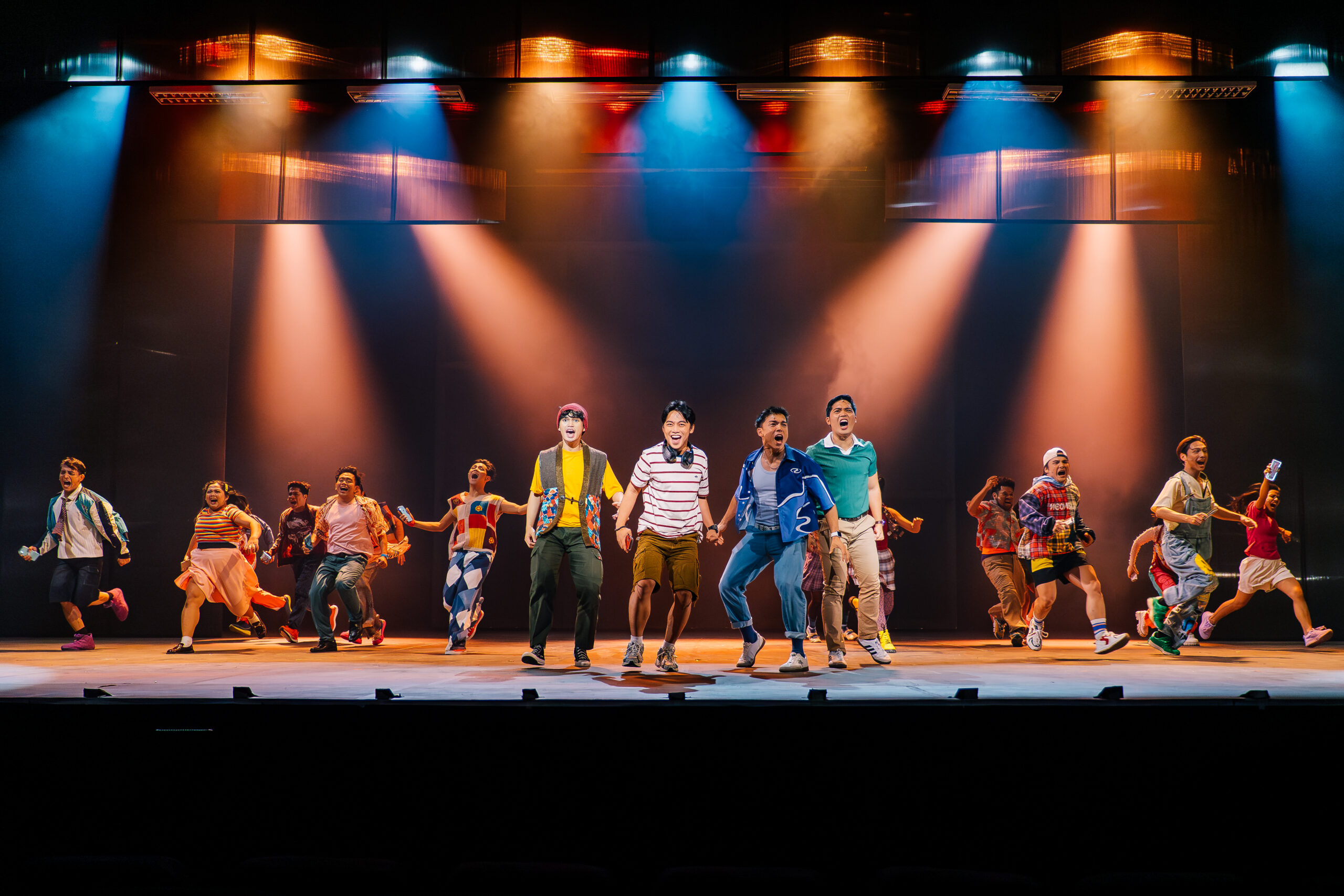
THE ROAD to success is a long one–but after two high-demand runs in 2024, it’s clear that Bar Boys: The Musical was an immediate hit for Barefoot Theatre Collaborative. This year, they return with the promise of amplifying every single element of the show. From the production design and choreography to the cast itself, Bar Boys found a place to land in this revitalizing new staging by director Mikko Angeles.
When sitting among the audience, the punching opening song sweeps you up as it catapults the whole show with a special kind of thrumming energy. The hopes and aspirations of the young generation come into view as “May Singil Ang Pangarap” (Dreams Have A Cost) is sung in harmony. From here, it becomes immediately clear how Myke Salomon’s musical direction emboldens the determined and optimistic story written by Pat Valera, and with their joint work on the lyricism, they have seemingly mastered the art of tugging on heartstrings with a sway of music.
Altogether, the incredible talent of the cast and the power of the artistic team carve a special place for themselves in the scene of Philippine theater.
A fresh face on hope
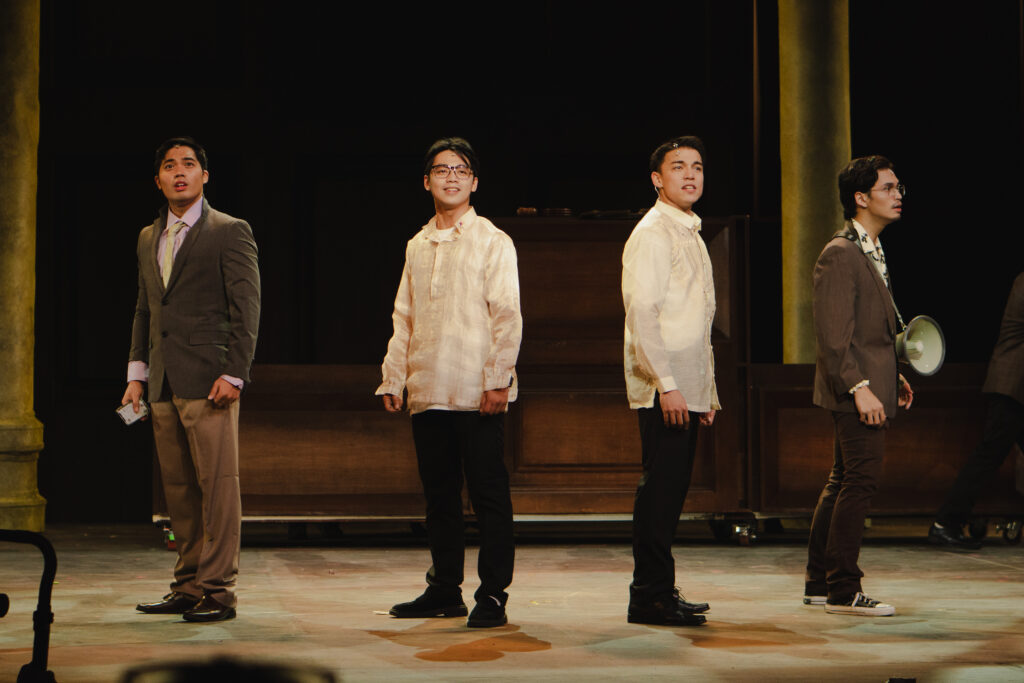
Photo courtesy of Raffy Cabrera
Bar Boys’ spotlight shines on four friends who each have their own individual conflicts amid their collective decision to enroll in law school. Primarily, the story centers on Erik Vicencio (Benedix Ramos), who struggles to justify the finances of further education with his Paping (Juliene Mendoza) as his sole provider, and Chris Abueva (Alex Diaz), a Filipino raised in America who is excessively optimistic about changing his home country for the better. Meanwhile, Torran Garcia (Jerom Canlas) contests his recently discovered queerness with his internalized homophobia, and Josh Zuniga (Omar Uddin) grapples with the pursuit of activism despite the academic pressures of law school.
On the other hand, Justice Hernandez (Sheila Francisco), who practices a firm and unrelenting stance in her instruction of the law, acts as one of the most empathetic characters in the show. Her standout solo “Tunay na Tao” demonstrates the need for compassion and excellence when dealing with cases and the lives of people. Her sacrifices as a judge and attorney are made not just for her, but for others. She even makes the powerful decision to go pro bono when defending Paping in a lawsuit filed against the corrupt corporation of the infamously immoral Atty. Maurice Carlson (Nor Domingo) for criminal negligence.
In contrast, the comedic renditions of the diverse ensemble of law school professors and students, of who are traditionally stoic figures, turns into the show’s biggest tension relievers. Notably, Natasha Cabrera as Female Professor and Carlon Matobato as Male Professor both give a hilarious, zany introduction to the world of law, humorously juxtaposing the horrific recitations and never-ending pile of readings assigned to students.
The background stars
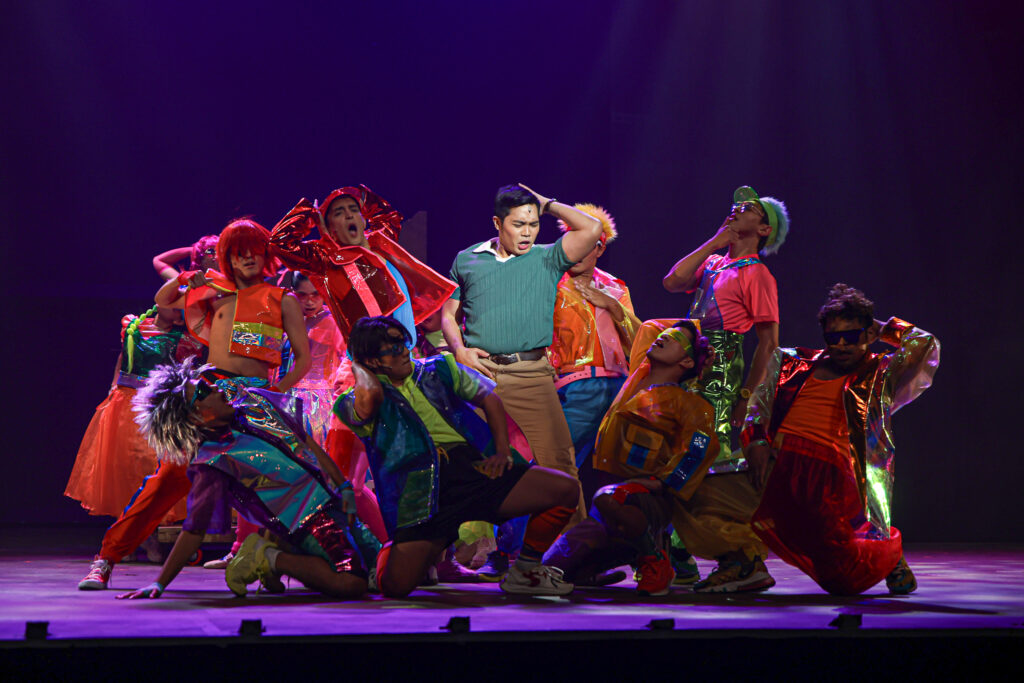
Photo courtesy of CJ Ochoa
All of the character and charm in Bar Boys, much of which comes from the cast, is further exacerbated by the artistic team’s effort. The costumes, choreography, and set work together to create a larger than life spectacle for the hopeful and idealistic world of the four law students.
Costume designer Hershee Tantiado perfectly translates the wide-eyed optimism of the characters in the first act, seen through each “bar boy” sporting distinct color motifs—red for Erik, blue for Chris, green for Torran, and yellow for Josh. The expressive and colorful costumes shine on the ensemble, who get their own visually defining aesthetics in the form of signature hairdos and unique statement pieces. These identities are all the more solidified when combined with the electrifying movement of Jomelle Era’s choreography, who breathes life into each beat and note of a song.
Similarly, the imaginative minds of set designers Ohm David and Julio Garcia use several moving set pieces that ebb and flow from one scene to another, taking advantage of Hyundai Hall’s bigger stage. One of the most noteworthy pieces is the massive bust of Lady Justice that sits ominously in the background, her blindfold representing impartiality in law. The piece, however, carries a twofold meaning: while the bust initially mirrors the students’ struggle to balance objectivity with flawed logic in legal cases, it also reflects the justice system’s inherent corruption when the said statue later becomes the office of the notorious Atty. Carlson, who exploits the system for his benefit.
The presence of this duality, most apparent in its dialogues and dramatics, added another layer of entertainment to the production. In the script and lyrics written by Valera and Salomon, they provide so many thoughtful lines: in one moment, you’re laughing at clever quips, and in another, you’re tearing up at the touching displays of sincerity shared in an intimate scene.
However, throughout the first act’s playful and long expository numbers, it became unclear as to where the plot was actually headed. The pacing issues become more apparent as the show transitions into the second act, which crams a lot of the story’s conflict, leaving little room for a breather and even less for proper resolutions. This drawn-out setup does, however, pave the way for great character development and many emotionally-driven scenes. Ramos and Diaz especially deliver a great performance, as the two best friends collide with the realization that they’re ultimately leading two different lives.
Crossing the line
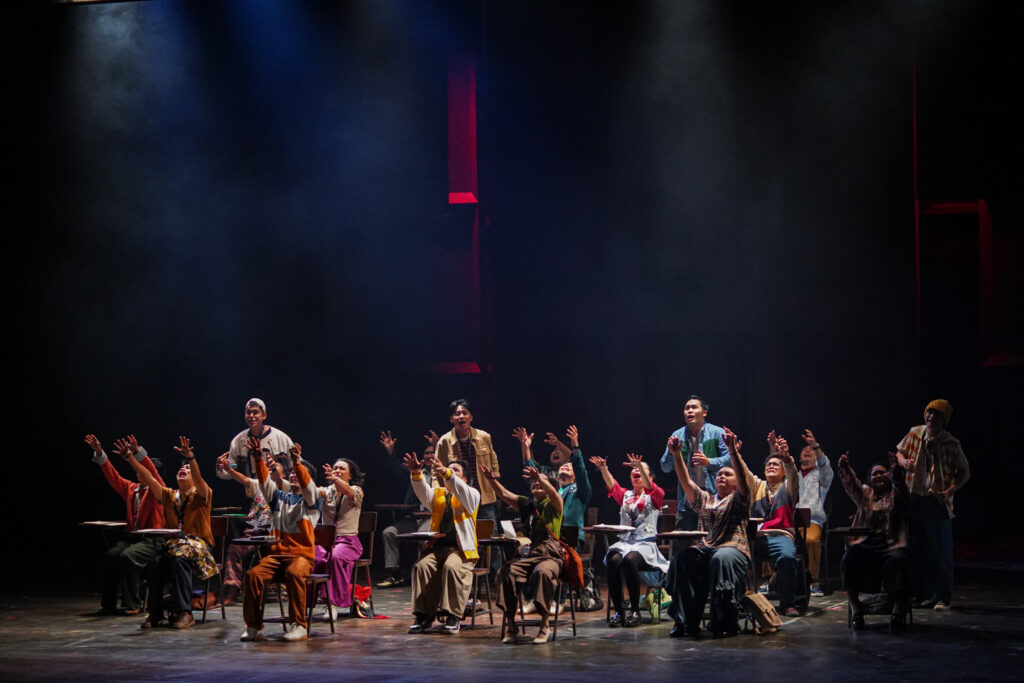
Photo courtesy of Kevin Sembrano
Despite being grounded in the harsh realities of injustice and prejudice, the world of Bar Boys ultimately transforms a perilous journey into a love letter for the Filipino youth, written with energy and care through song and dance.
While audiences learn about the gaps and shortcomings of our country’s justice system, there is an ever-prevailing question that lingers as the production carries on: “Is it worth it to fight and keep on going, as hard as it is?” The answer, as dispensed by the four friends, is a resounding yes.
As Bar Boys taps into relevant topics of nepo babies, climate crisis, and criminals in government positions, the production is more than familiar with the feelings of despair and loss that many of us discern in response to the country’s current state.
However, the show ultimately sticks to the idea that it is everyone’s duty to uphold dignity and fight for what is right, na karapat-dapat ka nga (you are worthy). Bar Boys: The Musical leaves its audience with a powerful truth: the truest measure of privilege is not what we gain, but the ability to give everything that we are to the people we love.

 Exposé