
 Theater & Arts
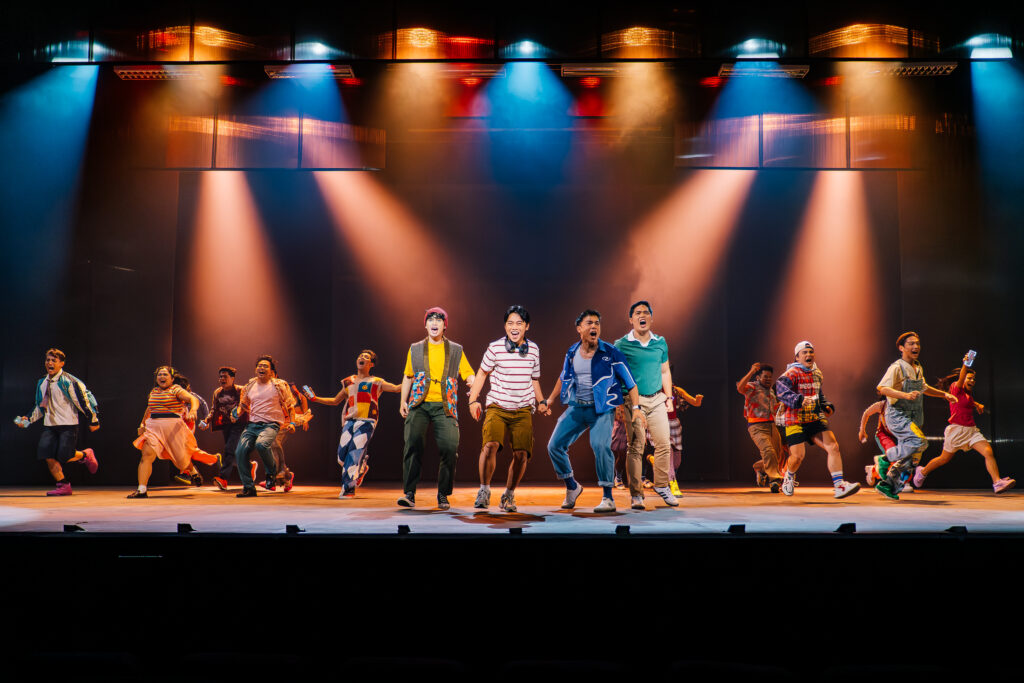
PROTEST TAKES many forms—each one requiring immense courage to carry over a resounding message. To start their 43rd season, Ateneo ENTABLADO mounted MAKIBAKA! Huwag…, a twinbill production that boldly highlights the plight of Filipino workers who have endured—from picket lines to online discourse.
The show’s two-hour runtime is divided into adaptations of both classic and contemporary plays: Orlando Nadres’ Paraisong Parisukat and Eljay Castro Deldoc’s Pilipinas Kong Mahal With All the Overcoat, respectively. Helmed by the directorial tandem of Jethro Tenorio and Joy Delos Santos, ENTABLADO blurs the line between spectacle and reality through a worldbuilding that extends far beyond their stage.
Thinking within the box
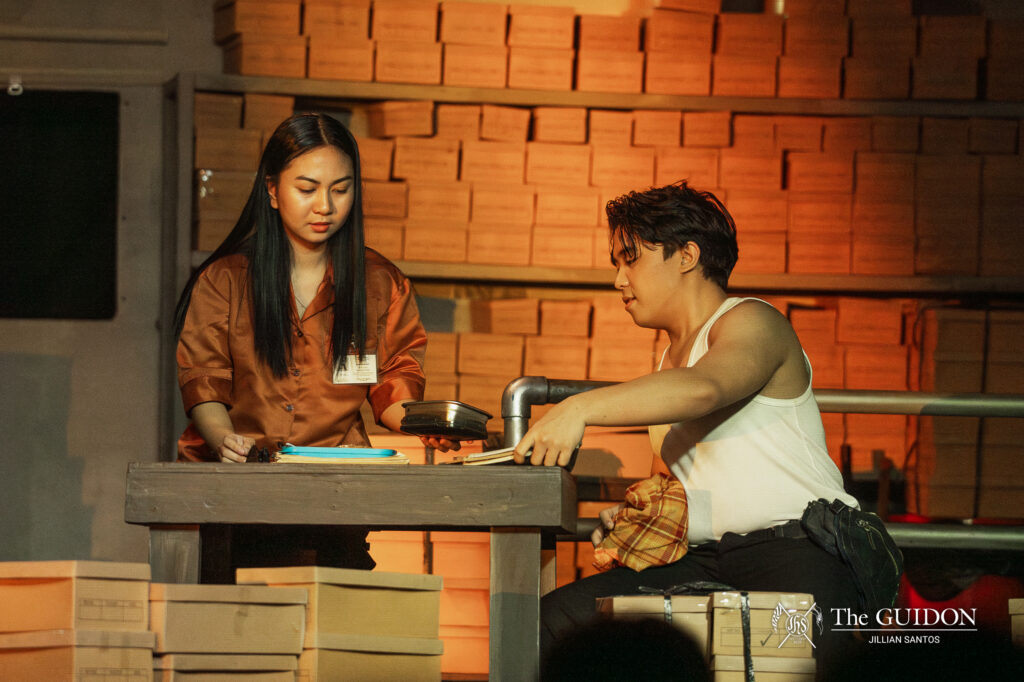
Photo by Jillian Santos
In Paraisong Parisukat, audiences are transported back to the Martial Law era through the four corners of Mira Shoes’ bodega. The curtains open with an acceptance speech by Leoraine Dela Cruz’s Isya (alternates Chantei Cortez and Allana Joy Boncavil), a timid model employee who is recognized for her work ethic yet trapped in a bleak, confined life.
Every day, she repeatedly yells back shoe orders before tossing boxes into a small window—as if merely a cog in the machine that keeps the store running. The script, humorous yet unflinching in its commentary, wastes no time ushering in its message: Should Isya and her co-workers be content with being restricted to the four corners of the stock room and the inhumane wages they are given?
While the entirety of the play operates within the bodega, Wika Nadera’s stage design and Chloe Juliana Cruz’s choreography masterfully demonstrate how much can happen within a single setting. Majority of the mise-en-scène is filled with cardboard boxes, save for a few chairs and tables. However, this does not impede the cast’s dynamics and instead places the audience’s focus on their animated movements and facial expressions.
From the friend who can’t stop ranting about her love life to the tito who pesters everyone with corny jokes, each of the workers feels familiar to Filipino viewers. Isya’s life feels less monotonous with them, especially the kikay Emy (Eunice Ann Reyes and alternate Claudette Galgana) and the crybaby Belen (Camille Balagtas and alternate Tini Flores). Together, the characters’ banter energizes the stage while also reflecting the struggles and desolation faced by the working class at the time.
Before the narrative feels dragging, a welcome change of pace comes with the introduction of Al (Luke Maverick Ang and alternate Ranz Aganan), a new hire whose ‘70s appeal mirrors today’s idea of “performative male.” Al’s chemistry with Isya not only adds entertainment value; his outspoken nature also plays a pivotal role in the development of her character, leading to the play’s conclusion.
In the final minutes, Dela Cruz effectively flips the switch on her acting, unveiling a disillusioned and infuriated Isya. She delivers a chilling monologue that reworks her opening speech—away from thanking her employers and toward demanding better treatment for every employee—before the stock room’s sudden collapse.
Smokes and screens
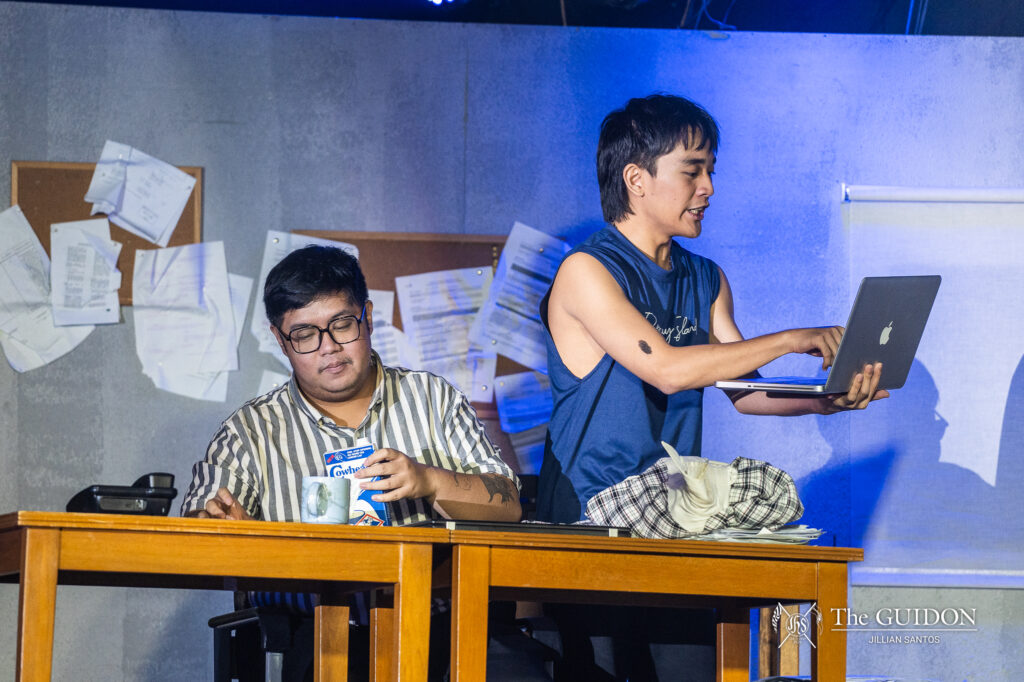
Photo by Jillian Santos
After a cathartic turn of events in the Mira Shoes bodega, the second play Pilipinas Kong Mahal with All the Overcoat trades the retro setting for today’s shiny age of social media. Audiences are welcomed into a modern unit that serves as the headquarters for Nato (Kyle Tano and alternate Uriel Dolorfino) and Ambet’s (Rick Pingol and alternate Alex Limjoco) website dikasure.com.
In contrast to the direct oppression in Paraisong Parisukat, Nato and Ambet mirror the reality of workers who are forced to swallow their morals for a slightly more comfortable life. What started as their avenue to write became a vehicle for disinformation and historical revisionism, serving clients who benefit from lies and deception.
Naturally, going after another play’s climax makes it challenging for Pilipinas Kong Mahal with All the Overcoat to establish its exposition. Built on the two leads’ conversations and their devices’ projections, the introduction to its premise and characters does not easily connect with the audience.
Where the narrative truly comes alive is in its segments, with the plot picking up pace as three clients step onto the stage. Whether it is a network representative (Ron Abustan and alternate Rick Pingol), a religious leader (Gabriel Nathan G. Pacardo and alternate Uriel Dolorfino), or a senator’s underling (Ronabelle Saunders and alternate Czrille Canonigo), the supporting characters depict how manipulating the information landscape has consequences that stretch far beyond the online sphere.
Despite some lapses in line mastery, Tano’s Nato effectively paints the moral grayness of wanting a better life for oneself at the expense of feeding lies into public consciousness. Similarly, Pingol’s Ambet captures the internal battles that come with choosing between principles and practicality.
Amid its chaotic ending—which involved a comical yet tense struggle over a gun—the play does not tell the audience whether the protagonists are good or bad. Instead, it leaves the lasting impression that the working class could never win as long as they remain subject to the demands of the more powerful.
Timeless wounds
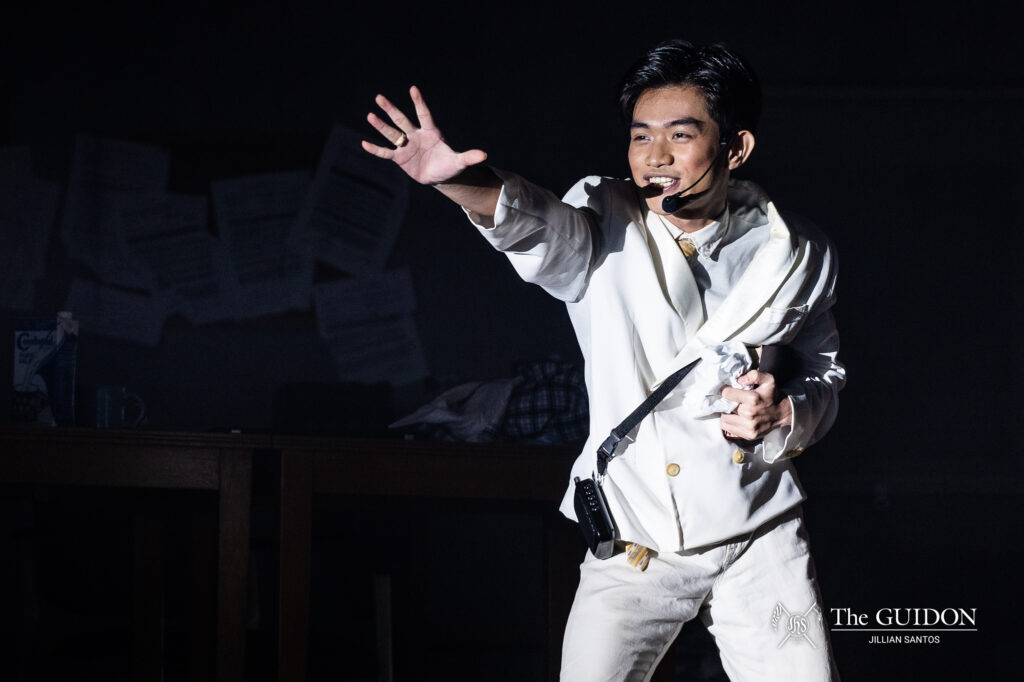
Photo by Jillian Santos
Weaving two narratives tied to distinct eras, not just in setting but also in conflict, is a tall order for any production. However, MAKIBAKA! Huwag… leverages the plays’ uniqueness to immerse audiences in two disparate worlds that ultimately illustrate how injustices faced by the Filipino working class persist through time and space.
Beyond the traditional set and props, projection designer Beatrice José crafted additional visuals that further evoke the time periods—from fragmented updates on the labor movement during Martial Law to parodies of present-day internet feeds. In this staging, ENTABLADO goes beyond inviting spectators into the world they have built. Every element works together in bringing that world beyond the platform, carrying the plays’ calls closer to the ears they seek.
Whether confined in a cramped bodega or flowing through social media’s endless span, MAKIBAKA! Huwag… unwaveringly carries the message that the oppression of Filipino laborers should never be buried under dusty shoe boxes or a biased algorithm.