

 Theater & Arts
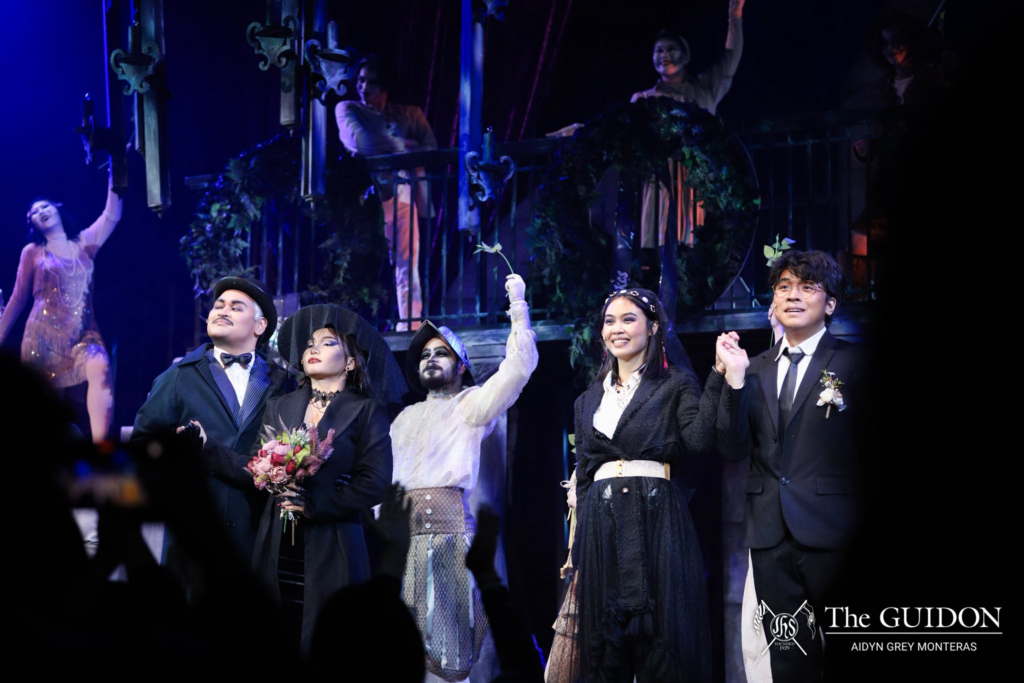
CAN THE Addams Family set aside their signature macabre for “one normal night?” Initially adapted by the Ateneo Blue Repertory in 2016 as a Newbie Production, director Jillian Ita-as returns The Addams Family to the stage for blueREP’s semester finale.
This musical comedy throws the Addamses’ world off-kilter when Wednesday—their perfectly morbid eldest daughter—falls in love with Lucas Beineke, an ordinary boy. What ensues is not too different from the usual family function: escalating passive-aggressive remarks, dramatically unearthed secrets, and lessons of what it truly means to be family.
Pulled in a new direction
How do you organize a family reunion the Addams way?
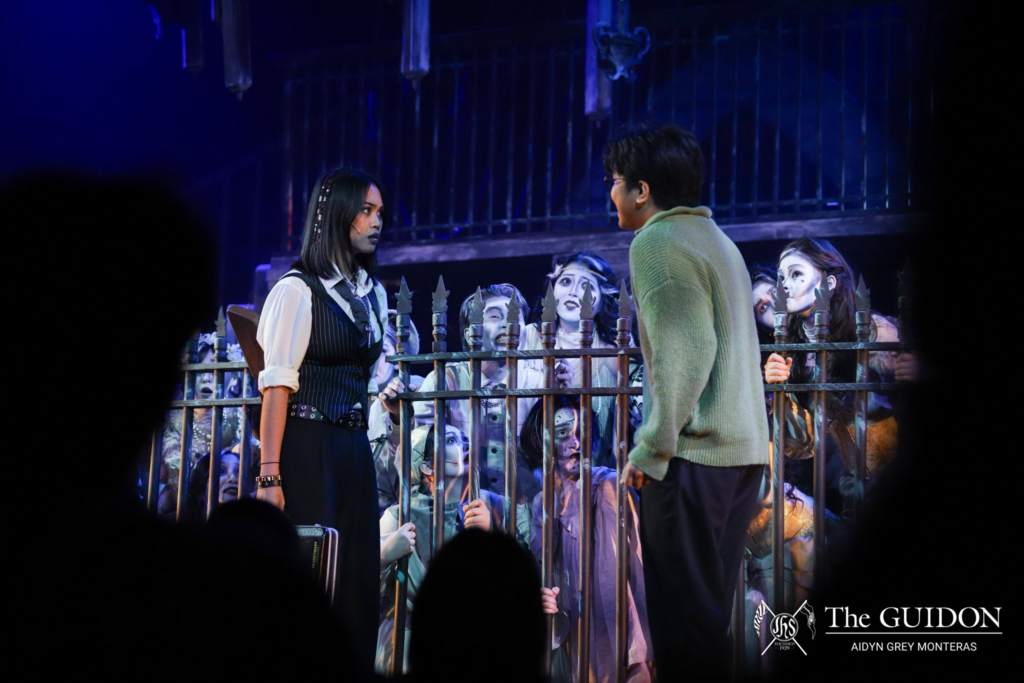
The Addams Family begins with the titular clan summoning their ancestors’ ghosts for a necromantic homecoming. Later, it is revealed that their beloved eldest daughter, Wednesday (LJ Bala and Maria Prats), is smitten with her unassuming fiancé Lucas Beineke (Anthony Luna)—whom she is sure her parents would disapprove of. Lucas, the son of Mal (RJ Panderayon) and Alice Beineke (Eli Pueblo and Sara Sicam), comes from the conventional Ohioan family, an antithesis to the Addamses’ grisly lifestyle.
Neither family is thrilled at the prospect of their children’s marriage. Wednesday forces her father, Gomez (Ron Balgos and Rafael Jimenez), to keep her engagement a secret from her mother, Morticia (Dia Papio and Riri Dauigoy), jeopardizing her parents’ own marriage.
Meanwhile, Wednesday’s little brother Pugsley (Aleczandra Luna) schemes in the shadows, flipping their family dinner on its head and forcing the Beinekes to confront—and maybe even embrace—their own inner darkness.
Following Director Jillian Ita-as’ promise to combine “theater, horror house, [and] drag musical” in this staging of The Addams Family, blueREP delivers with its flamboyantly spooky production.
Jethro Nibaten’s lighting design, meanwhile, proves that darkness doesn’t need to be dull. In the show’s opening, the characters’ silhouettes dramatically flicker, building anticipation until the entire stage illuminates for the opening number.
Nibaten’s design remains inspired throughout the entire musical, hitting beats of comedy and drama. The dynamic lighting emphasizes the eccentricities of Paul Atienza’s choreography, which ironically pairs deadpan facials with funky jazz movements.
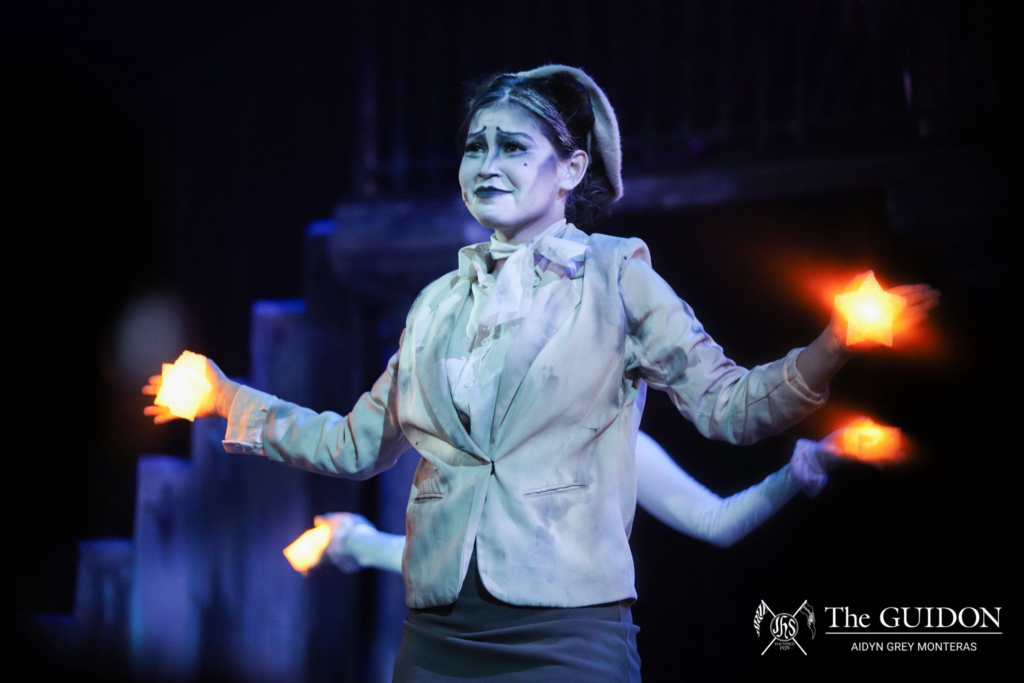
Embracing familiar horror motifs, production and brand designer Paw Castillo’s Addams home evokes a haunted house, with its dilapidated Gothic pillars and spindly, weathered railings. Against this creepy backdrop, costume designer Frances Cagurangan styles the ensemble with ghoulish make-up and grey period costumes to enhance their campy charm.
The living, dead, and undecided
In portraying characters known for their grim demeanors, the cast must reconcile staying true to their deathly eccentricities while still portraying a human (or at least human-like) being with a beating heart. CJ Isip, who plays the zombie butler Lurch, emphasizes the need to balance portraying a character who is “so still…yet so full of life.”
Bala (alternating with Prats) is magnetic as the mordantly cool Wednesday. She shares how she humanized the iconic character with a “[soft] curiosity about life” beneath her signature “stoic” surface.
Wednesday’s most vulnerable moments transpire with her parents: the sultry Morticia and passionate Gomez. Portrayed by Dauigoy (alternating with Papio) and Balgos (alternating with Jimenez) respectively, the couple exudes palpable chemistry and equal amounts of charisma onstage.
Between the two, however, Balgos does most of the emotional heavy lifting, showering his scene partner with believable adoration—be it Dauigoy, Bala, and even Panderayon.
Aleczandra Luna and Rona Layne Badilla are funny enough as the gremlin-like Pugsley and Grandma, respectively, but they tend to be overshadowed by the rest of the Addamses. Though Isip as Lurch lurks mostly in the shadows, he eventually reveals a soulful, full-bodied bass amid all his guttural growls in the previous acts.
If played by a less-skilled actor, the uncanny Uncle Fester (Steve Hotchkiss) would have risked boring the audience. However, Hotchkiss’ borderline slapstick humor and resonant vocals turn the story’s narrator into a crowd-favorite.
In contrast to the Addams family, the more subdued Beinekes underwhelm, possibly limited by the script’s insistence on their characters’ ordinariness. As an exception, Pueblo manages to break out of this trap in her portrayal of the seemingly bubbly Alice Beineke. When her character’s cheery facade shatters in the cathartic “Waiting,” Pueblo’s raspy belt evokes long-repressed, potent resentment that is both scathing and mournful.
Her stage son Anthony Luna plays the meek Lucas Beineke with a boyish appeal. Yet, save for his bold performance in “Crazier Than You,” he remains slightly forgettable. Both he and his stage father Panderayon stand out most when opposite their romantic interests—though this improvement may be partially attributed to the sparks of chemistry and friction lent by Bala and Pueblo, respectively.
Family first, family last
Though the narrative diverts much of its resolution to its three couples—Wednesday and Lucas, Morticia and Gomez, and Alice and Mal—the play’s strength lies in the interwoven story of the Addams and the Beinekes families as an ensemble.
“One Normal Night” is the production’s standout number, which features both Wednesday and Lucas imploring their families to keep the peace at the impending family dinner. The cast’s back-and-forth vocal rallies and chaotic choreography showcase a family dynamic that is both amusing and all too relatable. Above all, it shows the musical is at its best when it puts family at its forefront.
According to Bala, the musical highlights “the importance of community, specifically family.” Her co-star Prats agrees, adding the narrative’s emphasis on “the importance of individuality” and embracing what makes one unique.
Both messages—the value of family and the beauty of the individual—can be true all at once. Authenticity does not equate to self-ostracization, and choosing to grow with others does not mean neglecting your sense of identity.
The musical argues that the people you love ought to embolden the most unabashed version of yourself; in The Addams Family, you’re loved unconditionally—whether you collect deadly guillotines or adorable canaries. A true family encourages you to embrace all your quirks and edges—no matter how horrific these may seem.
 Exposé