
 Exposé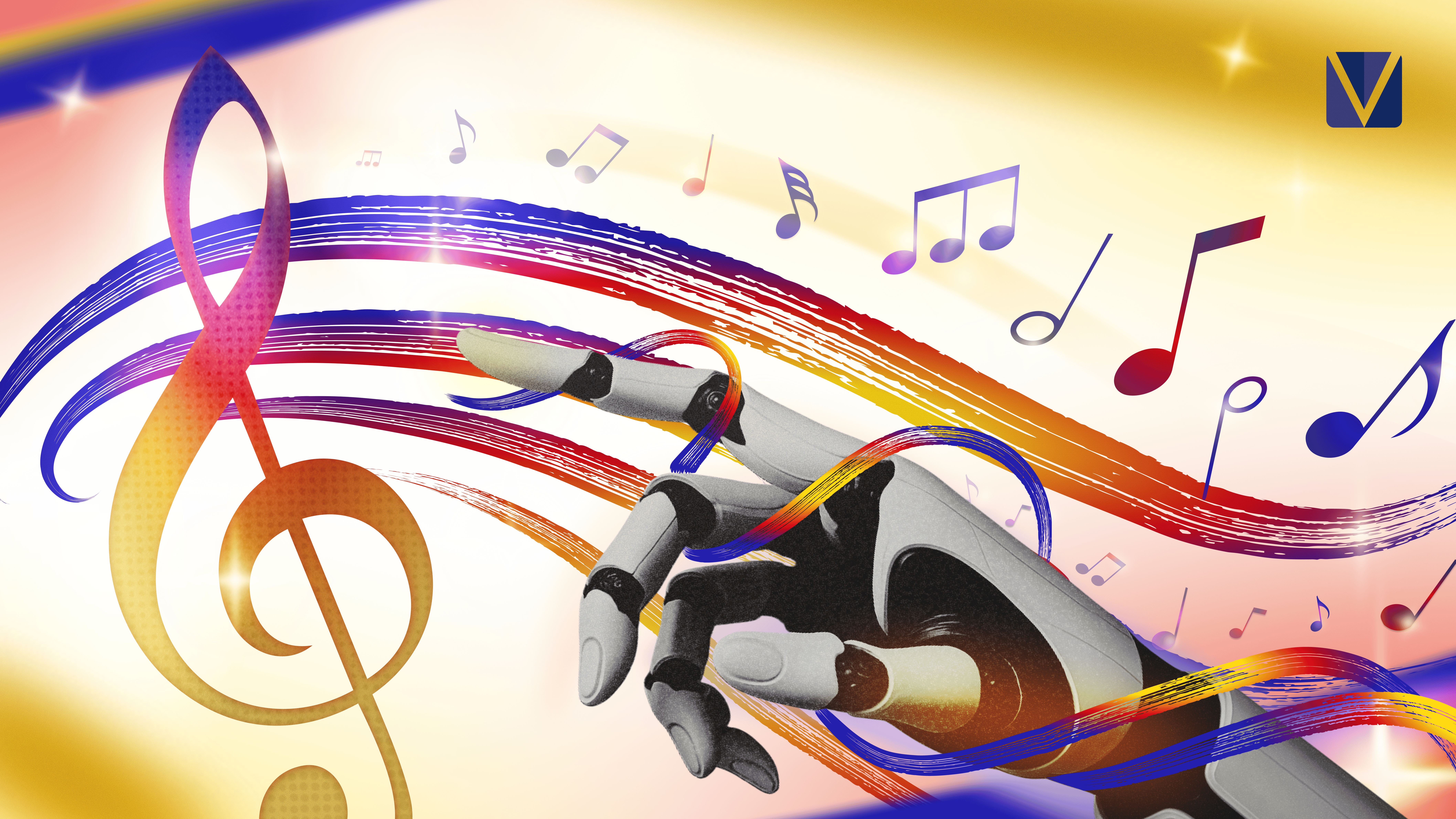
FILIPINOS LOVE music. Music evokes emotion, and emotion drives connection— bringing people together across generations and experiences. What happens when that feeling comes not from a human performer, but from a machine?
In recent months, the presence of artificial intelligence (AI) has been increasing across Filipino social media, particularly through AI-generated audios within the Original Pilipino Music (OPM) scene. On TikTok, these sounds are taking over feeds, becoming impossible to scroll past them without noticing.
In January, a jazz take on Regine Velasquez’s “Araw Gabi” brought AI-generated versions of local songs to wider attention. The following month, a funk AI cover of Willie Revillame’s “Buksan Mo” went viral online. By March, the “Hawak Mo ang Beat” sound was dominating feeds—catchy enough to pass as any other hit, yet sparking widespread online debate over whether it was AI-generated, as music producers attest to identifying possible markers of AI production while the track’s composer denies use of AI.
With AI being used across music platforms, Filipino musicians are grappling with a growing unease about who gets to create music and who deserves credit for it.
When AI hits the right notes
Long before AI was trained to produce even a single note, musicians have always relied on technology to expand the possibilities of their craft. Fine Arts Department Professor Allan Pastrana, whose work spans piano performance, music literature, and the history of Western music, situates AI within this longer tradition of artistic tools. “The arts have always relied on tools. That’s basically part of the whole notion of technology,” he says.
Over the centuries, musical advances like the refinement of instruments and the creation of the record player have transformed how music is made and how it reaches listeners. Yet, the increasing presence of AI is more consequential. AI can produce a full track with minimal human input, raising questions about authorship and authenticity. Unlike traditional tools that require skill to operate, AI simplifies the transition from idea to output, compressing what used to be hours of composition and recording into a matter of seconds.
Nathan Ong Ante (3 BS PS), a student-musician and the Ateneo Musicians’ Pool Associate Vice President for Artist Relations, first caught wind of AI music in 2022, viewing it as online experiments that did not demand attention at first. However, this shifted in 2025 when he was asked to perform for a band playing an AI-generated song at a dance event in Manila.
“We’re laughing at it now,” Ong Ante remarks, “but in the future, we will end up getting recommended a song on one of these platforms and [we] won’t be able to distinguish whether it’s AI or human-made.”
On the production side, some consider AI use to be practical. Brian*, an Atenean amateur classical guitarist who now creates AI-assisted songs for clients, describes AI as a convenient tool; clients provide lyrics and a genre, and the AI generates a track. Nonetheless, he notes, “I don’t think people who mostly rely on AI can call themselves musicians yet. […] However, I can see the tool being perfected and becoming much harder to detect in the future.”
Beyond practical considerations, Pastrana takes a step back to examine the bigger picture. While he appreciates AI’s potential as a creative aid, he still values the human intentionality behind artistic creation. For him, AI can be a tool, but it cannot replace the depth and authenticity of human experience in music.
A tool or a cheat code?
AI is often used to generate song covers that clone the voices of popular artists or reimagine the piece in a different genre, entertaining audiences who usually perceive it as a harmless remixing tool. These listeners focus on enjoying AI music’s sonic novelty, separating the art from the artist—or the lack thereof.
“At the end of the day, [AI-generated work] is still music [and might still] reflect, or even resonate, with people,” Ong Ante acknowledges.
For some listeners, AI also facilitates the transition to eventually creating music of their own. “[AI] makes certain parts of music creation easier and more accessible. […] You don’t have to be exceptionally skilled if you just want to create music for fun, or as a small gesture for people you love,” Brian explains.
Customers of his AI-assisted music service usually gift the final product to their loved ones. Yet, if what counts is the thought and effort behind a gift, then how much thought has been put into a made-to-order AI-generated song?
Critics of AI’s broader usage in the music industry follow a similar thread of reasoning: To them, what truly matters is the thought, talent, and toil behind a musical piece, not the completed soundbite itself.
However, technology has historically democratized skills, processes, and opportunities by making it easier for the layman to adopt. This begs the question of whether making any craft accessible inherently depreciates its merit—and if artists are expected to resist easier, more efficient processes to preserve their art’s perceived worth.
Echoing familiar stances surrounding many past technological developments, criticism towards AI stems partially from a fear of the unknown. With its rapidly-growing prevalence and seemingly unlimited potential, AI-assisted music is proliferating faster than the music industry can fully comprehend. “I know that I have to find a way, not necessarily to be happy about it, but to understand [AI’s role in music],” Pastrana admits.
As musicians confront the uncomfortable unfamiliarity of AI, they probe not only into its technological capabilities but also into their own notions of artistry. Pastrana himself is more interested in the fundamental questions AI raises about authorship and creativity. Alongside the growing popularity of AI-assisted music, these questions may foreshadow a fundamental shift in artists’ approach to their craft.
Art without an artist
As Ong Ante puts it, even if AI-produced songs technically “tick all the boxes” of music, listeners should still evaluate what makes music meaningful in the first place. For him, authenticity in music starts and ends with the human being behind the work.
“There is someone who basically put hours into making that song, [thought] of a melody while walking, [came up with] lyrics and wrote it down in their phone, meticulously aligned everything, recorded every single part, and then [played] it live,” Ong Ante explains. That full process—from ideation to embodiment—is something he believes AI will not be able to replace.
In the OPM scene, songs often go beyond their main purpose of entertaining—they also become diaries, protest statements like Freddie Aguilar’s “Bayan Ko” and Bamboo’s “Tatsulok,” and love letters to places and people.
OPM functions as a reflection of Filipino identity, shaped by sociopolitical realities and lived experiences. In turn, listeners do not just consume music; they connect with it, especially with stories that feel familiar and grounded in real lives.
Ong Ante notes that Filipino listeners have “a very strong sense of wanting to really see the artist.” Due to this, the live music culture thrives in bar gigs, campus concerts, and festivals. And ironically, he believes that as AI-generated music succeeds online, physical performances may grow even stronger.
“While the online space and recorded music might end up being threatened by AI […] the live music space [is something that] will even become stronger because of the advent of AI,” Ong Ante presumes.
In this regard, AI’s limitation is clearly seen when the music tries to be the voice of lived Filipino realities. While AI can recreate musical patterns and lyrical structures, it does not actually experience heartbreak, oppression, or community in the way that human artists do. “I feel that there is so much dignity to the processes involved in the creation of an artwork by a human being,” Pastrana declares.
Apart from questions of authenticity, there are more practical concerns, including labor, compensation, and the systems that reward visibility. Brian acknowledges that the process of producing AI music is not always inspired. “I won’t really say that I enjoy the act of producing music in itself. I mostly do it for the monetary benefits,” he confides.
This further complicates the narrative. AI is not always utilized out of artistic curiosity. Sometimes, it’s merely faster and more profitable as speed and scalability overpower intimacy and craft.
With this, Ong Ante underscores the importance of regulation in the music scene as a response to AI’s growing and unmanageable presence. Thus, he points to measures such as direct labeling, stronger guardrails, and differences in compensation as ways to look after the human creators’ recognition.
As the Philippine music industry faces the inevitable transformation brought by AI, regulatory measures are necessary to protect the livelihoods and artistic integrity of Filipino musicians. Technological innovation cannot be stifled, and change should be recognized rather than vilified; however, progress must not erode the human authenticity that makes OPM so special in the first place.
*Editor’s Note: The name of the interviewee has been changed to protect their identity and privacy.