
 TV & Film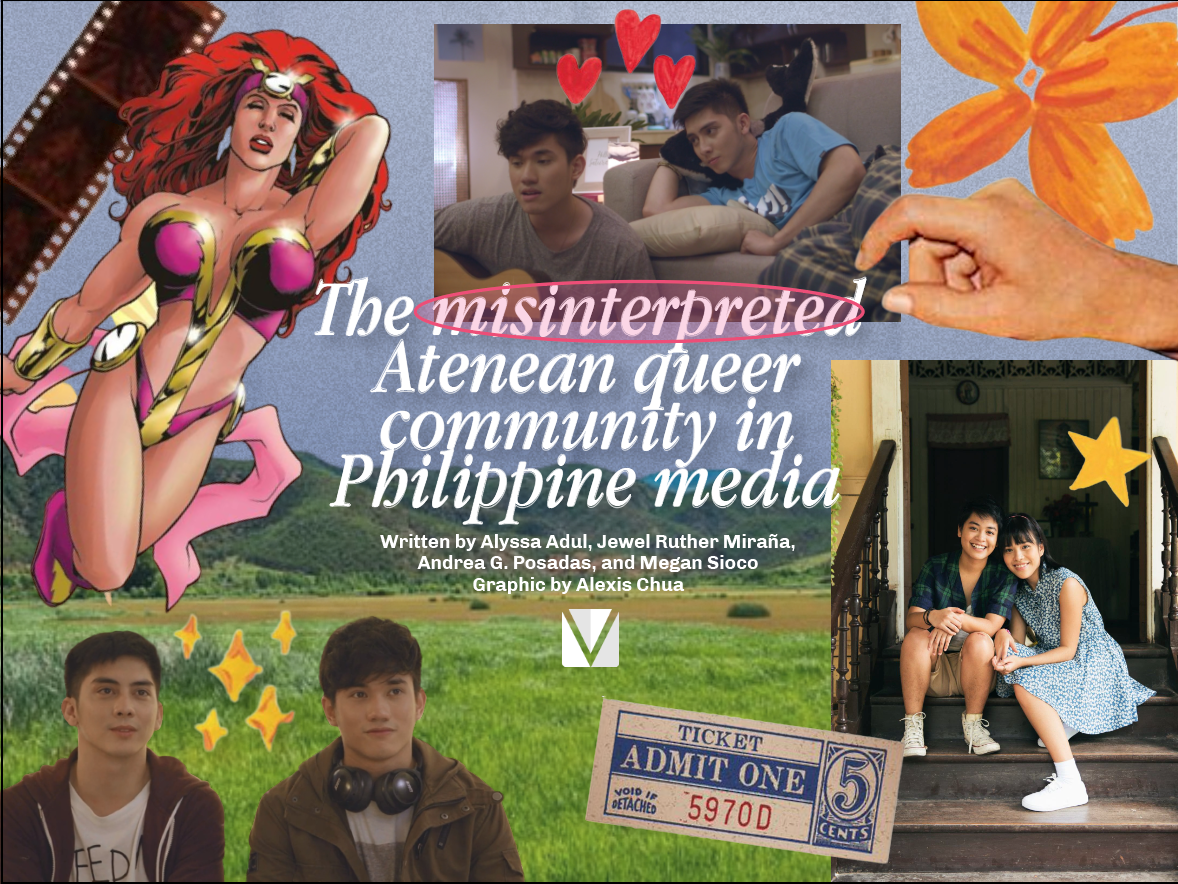
OVER THE years, queer Filipinos have succeeded in bringing their aspirations for equality and proper representation to the big screen. In turn, movie-goers and binge-watchers have been graced with empowering narratives of self-discovery and familial acceptance.
It’s one thing to admire these art forms and say they’ve changed our lives. However, witnessing the subtle stereotypes structuring such shows and films is a different case.
Despite queer creators’ conscious efforts to dispel harmful portrayals of their experiences, their work still offers offensive storylines on mainstream platforms. After the controversial Metro Manila Film Festival (MMFF) entry My Father, Myself (2022), the Ateneo community now leads a discussion on the nuances of queer misrepresentations in Philippine media—as well as how they curtail queer people’s freedom to love and understand romance in their own right.
A snapshot of queer love
When asked whether the mainstream Philippine media accurately represents LGBTQ+ love, Kevin Tejada (2 BS BIO) emphasizes, “Themes of cheating are prevalent. In the Philippines, there hasn’t been any stories of just two guys or girls falling in love without anyone cheating or dying.”
If not tragic, mainstream media also tends to depict LGBTQ+ people as comic relief by perpetuating “baklang kanal (flamboyant gay)” narratives. In that regard, queers are only tolerated when they do something that “appeases the public” like being “eye candy” to non-queers, according to Jericho* (2 BS HS).
Indeed, the Philippine entertainment industry has a long way to go in terms of what Tejada and Jericho describe as authentic representation.
However, Kristine Michelle Santos, PhD—an Ateneo History Department Assistant Professor whose work centers on queer media culture—provides a different perspective on the matter. She argues that the current queer narratives arise from the industry’s attempt to represent the audience’s current society, which is highly heteronormative, heterosexual, and heteropatriarchal.
“What is even an accurate representation of love anyway?” asks Santos.
From “good” representations to “bad” ones, she compels people to consider that proclaiming these depictions as either positive or negative is subjective to taste and other sociopolitical factors. Santos further states that some of these portrayals are “good” because they still make queer culture visible and spark discussion about it.
Undeniably, the rising influence of media on the development of new-age queer relationships must mean that the LGBTQ+ community is able to recognize themselves on the big screen.
Blurred expectations
On the contrary, Santos also concedes that queer representation in popular cinema can potentially become a gateway for preserving misconceptions and stigma around queer relationships.
By projecting storylines that show singular notions of queer love—like expectations on having a “boy” or a “girl” in a relationship—viewers may have warped concepts of how queer relationships actually work. In fact, even members of the LGBTQ+ community themselves may believe in these blurred expectations of love.
Regardless, it’s not so much about defining what’s real because the reality is that queer experiences are diverse. Hence, queerness itself cannot define what should occur in a queer romance.
Kassandra Yabut (1 AB IS) and Tejada both enumerate that the media fails to show the aspects queer relationships have in common with straight relationships, such as miscommunication.
“They (queer media) often show the hardship that queer people go through, and I am experiencing the same thing. It’s hard for me to fall in love, actually. There is always this fear that I have to be careful,” Jericho echoes.
Indeed, the need for more accurate and inclusive snapshots and representation of queer love is emphasized, especially since the media’s influence on personal relationships is boundless.
“The heart of queer culture is that it is not going to fit the audience’s moral standard because it is out there to question. The more our boxed up society is exposed to this culture, the more we come to understand the circumstances surrounding queer relationships and accept them,” Santos emphasizes.
A wider lens
When it comes to queer representation in the media, Santos laments on how these stories must always be rooted in tragedy. “Because of the internalized homophobia and heteronormativity present in society, it pressures gay people to the point that they can’t openly love each other,” she shares.
Majority of the country’s queer texts currently portray tragic realities, drawing back to the 1960s with Death of Venice (1971) and Midnight Cowboy (1969). However, these dominant narratives alienate many LGBTQ+ folk, including Atenean students.
“It’s entertainment, so I understand the part of dramatizing the struggles of people, but it doesn’t entirely represent what the [LGBTQ+] community wants to have,” Tejada remarks.
Thus, employing a wider lens to broadcast multiple queer narratives is more important as it affects how the community perceives themselves.
In fact, Yabut says that queer representation helps young members of the community find their identity. Emphasizing the impact of representation in society, Tejada adds, “What we portray sa films has a large impact on how we perceive these minorities.”
Ultimately, queer narratives need not be magnified under a limited lens but broadcasted as varied queer experiences.
Santos says, “Media has to work within this aspirational quality. Sometimes, [the] media is out there not to represent the full extent of reality but rather show the potential of reality.”
Fortunately, in recent years, Filipino cinema has seen the rise of narratives which stray away from its tragic or caricatural formula. Stories like Gaya sa Pelikula (2020) and Gameboys (2020) unlocked the potential for romance. Similarly, ZsaZsa Zaturnnah (2006) and Mga Batang Poz (2019) portray successful queer stories that showcase the community as the winners in their own stories.
In response to these narratives, Tejada expresses, “It’s inspiring to see that kind of wholesome love.” Thus, he feels optimistic about his future relationships.
Yabut also references the one-sided views of queer love in mainstream media and applauds indie short films, which represent her relationship experiences well. Through these, she says it is now possible to imagine love and happiness in queer stories.
This transition to the wider lens is a promising Pandora’s box, potentially enabling the spotlight to illuminate other representations. Moving forward, Tejada yearns to see portrayal of different sexual identities. Meanwhile, Jericho anticipates characters in varying age ranges such as middle-aged people experiencing midlife crises.
On the other hand, Yabut wants to see themes beyond romance, and representation other than the cis gay man. Finally, Santos asserts the need to show the narratives, expressions and experiences of queer women.
Although the rise of lighthearted films nowadays open up avenues for successful love stories reflecting these ideals, they still possess certain limitations.
For instance, queer films oftentimes fall back into questionable tropes, showcasing only the “bakla” caricature and using gay relations as plot devices. The demand for inclusive representation thus persists, begging the question: How accurately is society willing to portray the queer community? For instance, Santos asks, “Are we prepared to show narratives of Tinder hookups?”
Whichever side one may be on, there remains the loud call for queerness to reach mainstream consciousness. “The more kinds of queer love we see, the more we learn to accept various queer possibilities,” Santos hopes.
Queerness has always described itself as defining boundaries. In a crucial time where the visibility onscreen matters most, there is pressure on the film industry to push the boundaries of queer expressions and narratives. Hopefully, there will come a time when the portrayals of the community will truly deserve their every peso and praise.